The Cloud Isn't Infallible
In December 2021, AWS experienced a major outage that took down thousands of websites and services. In 2023, Microsoft Azure had multiple incidents affecting global operations. Google Cloud has had its share of disruptions. The message is clear: no cloud provider is immune to failure.
The average cost of cloud downtime for enterprises is $5,600 per minute. For e-commerce companies during peak seasons, it can exceed $100,000 per minute. Yet many businesses still operate with a single point of failure.
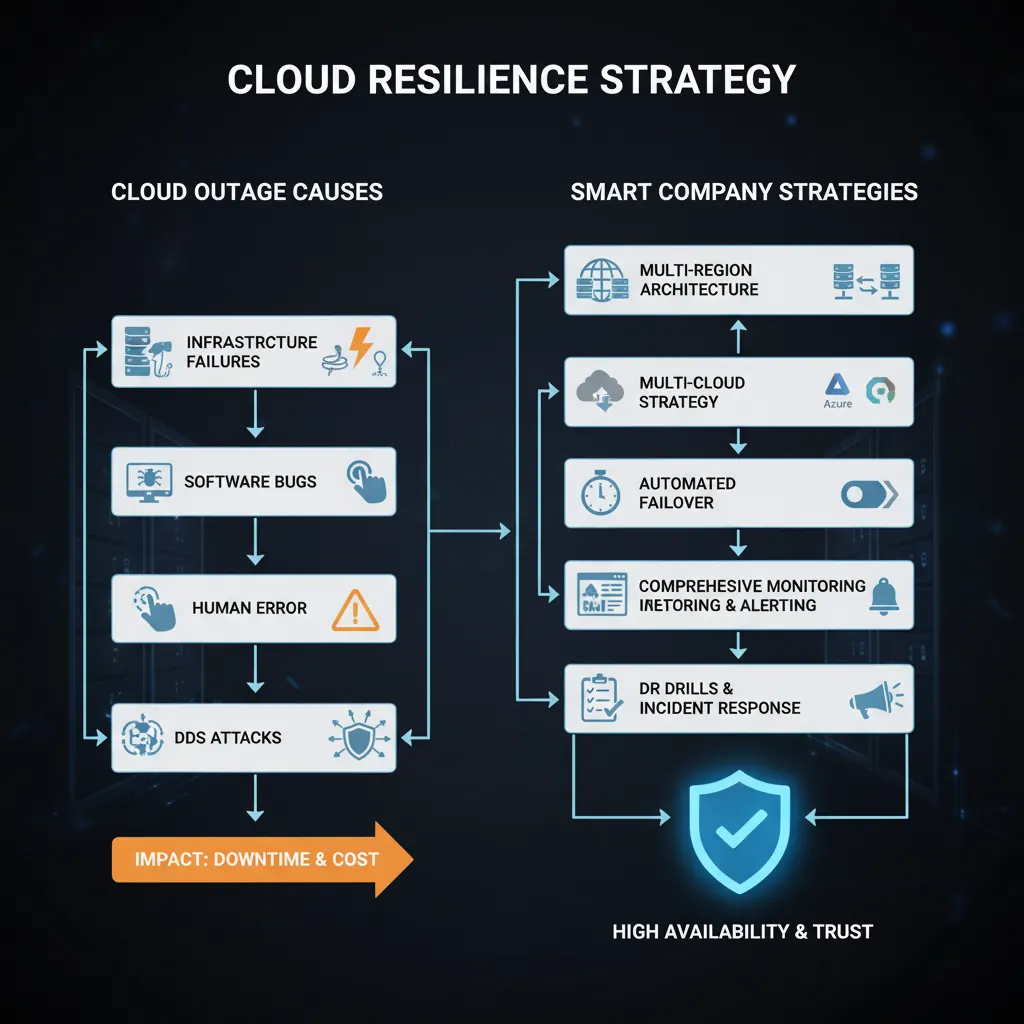
What Actually Causes Cloud Outages?
Infrastructure Failures
Hardware fails. Data centers lose power. Network equipment malfunctions. Even with redundancy, failures can cascade.
Software Bugs
A single misconfigured update or buggy deployment can bring down entire regions. The worst outages are often software-driven.
Human Error
Misconfigurations, accidental deletions, and incorrect deployments cause more outages than most companies admit.
DDoS Attacks
Distributed attacks can overwhelm even large providers, blocking legitimate users.
How Smart Companies Stay Online
Multi-Region Architecture
Deploy critical applications across multiple regions. If one fails, traffic routes to healthy regions. Plan carefully for data consistency and latency.
Implementation: Load balancers with health checks, cross-region database replication, automated failover.
Multi-Cloud Strategy
Avoid single-provider risk for truly mission-critical systems by deploying across AWS, Azure, and Google Cloud.
Reality Check: Multi-cloud adds complexity and cost. Use it where downtime is unacceptable.
Automated Failover
Manual failover is too slow. Automate detection and switchovers to react in seconds.
Key Components:
- Health checks that continuously monitor system status
- Automated traffic routing based on health status
- Database replication with automatic promotion of replicas
- DNS failover with low TTL values
Chaos Engineering
Deliberately break things (safely) to test resilience. Netflix pioneered this with Chaos Monkey.
Start Small: Begin with non-critical systems during low traffic, then expand scope as confidence grows.
Comprehensive Monitoring and Alerting
Detect issues early with layered monitoring:
- Synthetic monitoring (simulated transactions)
- Real-user monitoring (actual UX)
- Infrastructure monitoring (resource utilization)
- Application performance monitoring (code-level)
Regular Disaster Recovery Drills
Plans are useless if untested. Run DR drills regularly.
What to Test:
- Complete region failover
- Database restoration from backups
- Communication protocols during incidents
- Rollback procedures for bad deployments
The Cost-Benefit Calculation
How Much Resilience Do You Need?
Not every system needs 99.999% uptime. Calculate downtime cost per system and invest accordingly.
- Mission-Critical: Multi-region, automated failover, 24/7 monitoring
- Business-Critical: Single region + automated backups, business-hours monitoring
- Non-Critical: Standard backups, best-effort recovery
When Disaster Strikes: Incident Response
Have a Clear Incident Response Plan
Define notification paths, decision owners, and communication protocols ahead of time.
Communicate Proactively
Use status pages and provide ETAs. Silence erodes trust.
Conduct Post-Mortems
Run blameless post-mortems, fix root causes, and share learnings when possible.
The Reality of Cloud Resilience
Perfect uptime is impossible. The goal isn't to prevent all failures—it's to minimize impact and recover fast. Architecture, automation, monitoring, and practice keep you online when others go dark.
At Neyndra, we design and implement resilient cloud architectures that withstand failures.