
The Data Paradox
Companies today collect more data than ever before—website clicks, customer transactions, sensor readings, social media interactions. Yet most organizations struggle to turn this data into actionable insights. The problem isn't lack of data; it's the gap between data collection and data-driven decision making.
According to recent research, only 26% of companies have achieved a data-driven organization. The rest are drowning in spreadsheets, struggling with siloed systems, and making critical decisions based on gut feeling rather than evidence.
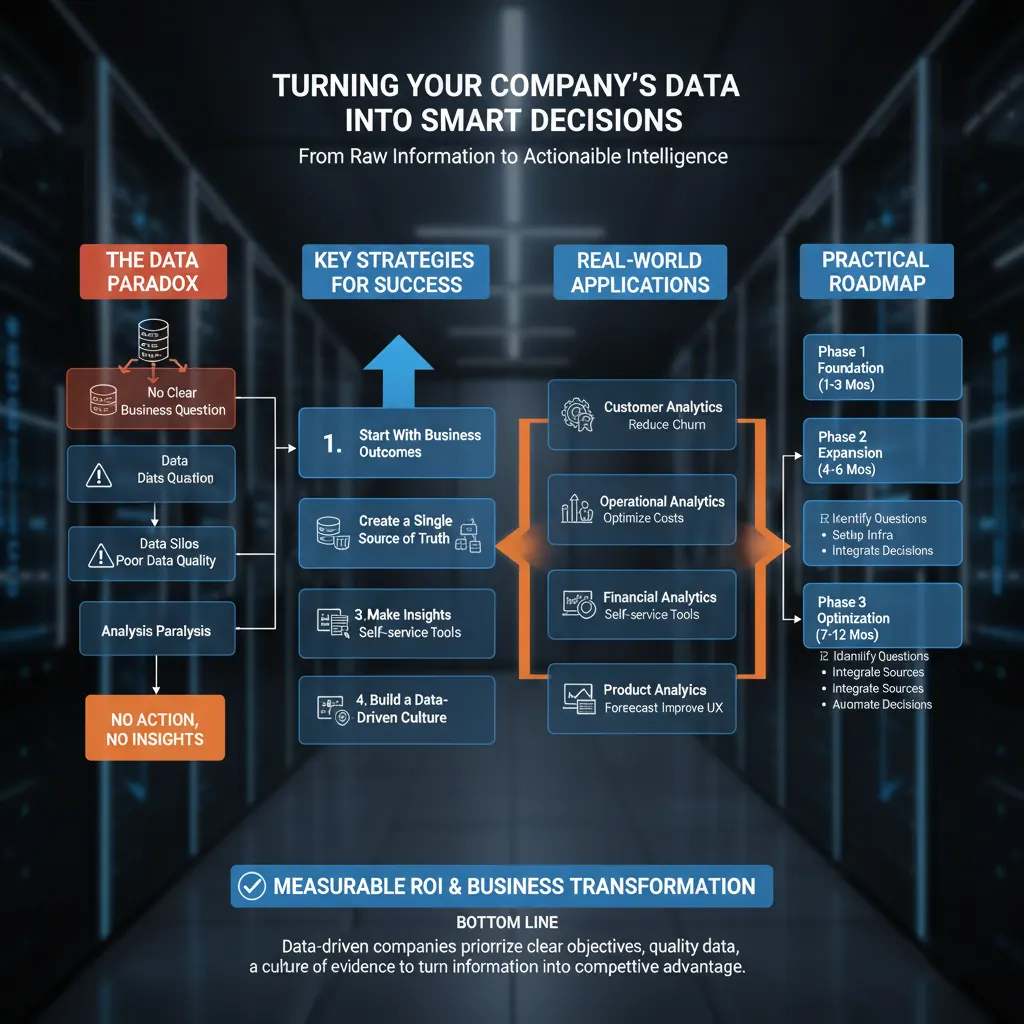
The Four Pillars of Data-Driven Decision Making
1. Start with Business Questions, Not Data
Don't start with the data you have—start with the questions you need answered. What decisions are you trying to make better? Where are your biggest uncertainties? Which metrics truly drive your business?
Key Approach: Work backwards from business objectives. Identify critical decisions, then determine what data and analysis would improve those decisions.
2. Invest in Data Quality and Accessibility
Garbage in, garbage out. Poor data quality is the silent killer of analytics initiatives. You'll spend 80% of your time cleaning and preparing data if you don't invest in quality upfront.
Best Practices: Implement data governance, standardize definitions across teams, automate data quality checks, and make clean data easily accessible to decision makers.
3. Democratize Data Access (With Guardrails)
Bottlenecking all analysis through a small data team creates delays and frustration. Empower business users with self-service tools—but provide the right training, governance, and support.
Implementation: Use modern BI tools with intuitive interfaces, create curated datasets for common use cases, and establish a center of excellence for advanced analytics.
4. Build a Data-Driven Culture
Evidence over opinion. Train, measure, and reward data-driven decisions.
Cultural Shifts:
- Require data to support major decisions
- Celebrate decisions made on data (even if unlucky)
- Make data literacy a core competency
- Create feedback loops to measure decision quality
Practical Applications That Drive Results
Customer Analytics
Personalize marketing, improve products, and reduce churn.
Real Impact: SaaS company reduced churn by 23% via early-warning usage signals and proactive outreach.
Operational Analytics
Find bottlenecks and inefficiencies; optimize processes to cut costs.
Real Impact: Manufacturer cut production costs 15% by analyzing utilization and optimizing scheduling.
Financial Analytics
Forecast performance and flag risks with predictive analytics.
Real Impact: Services firm improved cash flow 30% by identifying late payers and adjusting credit terms.
Product Analytics
Prioritize features and improve UX by understanding usage patterns and friction.
Real Impact: Mobile app increased engagement by 45% after removing onboarding friction.
The Modern Data Stack
Data Collection — Track events, transactions, and integrate third-party sources.
Data Storage — Choose warehouses (structured, query-optimized) or lakes (flexible, all types).
Data Processing — Clean, enrich, aggregate, and join raw data into analysis-ready formats.
Data Analysis — Use statistics, ML, and BI tools to extract insights.
Data Activation — Turn insights into action via automation, recommendations, or alerts.
Getting Started: A Practical Roadmap
Phase 1: Foundation (Months 1–3)
- Identify 2–3 high-impact business questions
- Audit existing data sources and quality
- Set up basic data infrastructure
- Create initial dashboards for key metrics
Phase 2: Expansion (Months 4–6)
- Integrate additional data sources
- Implement self-service analytics tools
- Train business users on data tools
- Establish data governance processes
Phase 3: Optimization (Months 7–12)
- Add predictive analytics capabilities
- Automate routine decisions based on data
- Scale successful use cases across the organization
- Continuously improve data quality and processes
The Bottom Line
Data is only valuable when it leads to better decisions. The winners aren't the ones with the fanciest tech, but those who systematically turn information into action.
Start small, focus on high-impact questions, and build incrementally. Invest in data quality and accessibility. Above all, build a culture where decisions are based on evidence, not intuition.
At Neyndra, we help organisations build data capabilities that drive real business results. We don't just implement technology—we transform how companies make decisions.