
The Reality Behind the AI Hype
While everyone talks about AI, only a fraction of businesses are actually deploying it effectively. The gap between AI aspirations and AI implementation has never been wider. But some companies are getting it right—and the results speak for themselves.
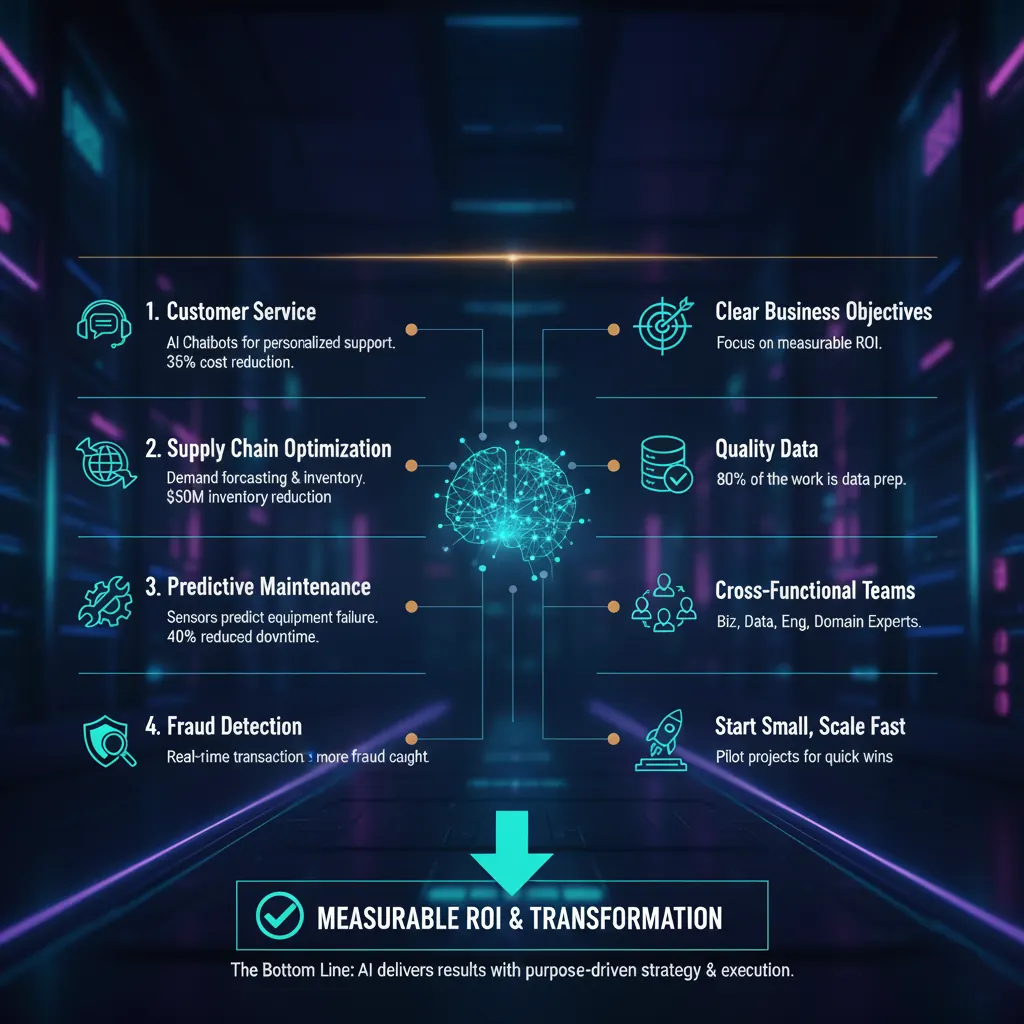
Real-World AI Applications That Work
1. Customer Service Transformation
Leading retailers are using AI-powered chatbots that don't just answer FAQs—they understand context, sentiment, and purchase history to provide personalized support. One major e-commerce company reduced support costs by 35% while improving customer satisfaction scores by 28%.
Key Implementation: Natural Language Processing (NLP) models trained on millions of customer interactions, integrated with CRM systems for personalized responses.
2. Supply Chain Optimization
Manufacturing companies are deploying AI to predict demand, optimize inventory, and prevent stockouts. A Fortune 500 manufacturer reduced excess inventory by $50M annually while improving on-time delivery rates.
Key Implementation: Machine learning models analyzing historical sales data, market trends, weather patterns, and economic indicators to forecast demand with 95% accuracy.
3. Predictive Maintenance
Industrial companies are using AI to predict equipment failures before they happen. One energy company reduced unplanned downtime by 40% and saved $12M in maintenance costs in the first year.
Key Implementation: IoT sensors feeding real-time data into AI models that detect anomalies and predict failures 2–4 weeks in advance.
4. Fraud Detection
Financial institutions are catching fraud faster and more accurately than ever. AI systems analyze transaction patterns in real-time, reducing false positives by 60% while catching 25% more actual fraud.
Key Implementation: Deep learning models trained on millions of transactions, continuously learning from new fraud patterns.
What Makes These Implementations Successful?
- Clear Business Objectives: Specific, measurable goals with ROI defined upfront.
- Quality Data: Heavy investment in cleaning and preparation; the 80/20 rule applies.
- Cross-Functional Teams: Blend business stakeholders, data scientists, engineers, and domain experts.
- Start Small, Scale Fast: Pilot quick wins, then scale proven solutions.
Common Pitfalls to Avoid
- The "AI for Everything" Trap: Sometimes rules or analytics are better.
- Ignoring Change Management: Adoption needs training, comms, and value proof.
- Underestimating Maintenance: Models need monitoring, retraining, and updates.
The Bottom Line
AI is no longer experimental—it's a proven business tool when implemented correctly. The companies winning with AI share common traits: clear objectives, quality data, cross-functional collaboration, and continuous improvement.
The question isn't whether to use AI, but where to start. Focus on high-impact, well-defined problems where you have good data and clear success metrics. Start small, prove value, then scale.
At Neyndra, we help businesses move from AI aspiration to AI implementation. We focus on practical solutions that deliver measurable ROI—not science projects.